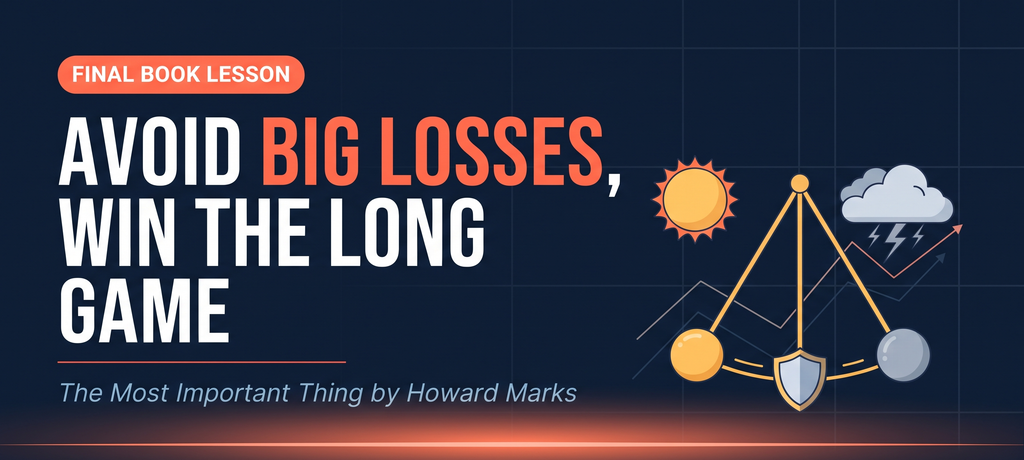
The Most Important Thing by Howard Marks: Why Avoiding Big Mistakes Beats Chasing Big Wins
Most of us think investing is about finding the next big winner: the hot stock, the trending fund, or the tip from a friend who “made a fortune.” If you are searching for practical Howard Marks investing lessons, this book offers a completely different lens. What if the real secret isn’t picking winners at all, but rather avoiding big losses and staying calm while everyone else panics? That’s the heart of The Most Important Thing by Howard Marks, co-founder of Oaktree Capital. Applying these timeless Howard Marks investing lessons helps you navigate uncertainty with a steady mindset. You can read more about his philosophy on the official Oaktree Capital Insights Page (Set this link to DoFollow in WordPress). It’s a book about deep thinking: how to understand risk, respect market cycles, and make sensible decisions when emotions run high. Warren Buffett has famously praised Marks’ investor memos, and this book pulls those masterclass ideas together. For a mindful money blog, this is a perfect final chapter. Let’s break down the core Howard Marks investing lessons that matter most to help you protect your capital. 🌿 🧠 Lesson 1: Essential Howard Marks Investing Lessons on Second-Level Thinking Marks talks about two ways to think about investing: First-level thinking is simple and shallow. Everyone does it. Second-level thinking asks what the crowd believes and where it might be wrong. You can’t beat the market by thinking the same way as everyone else. That doesn’t mean being contrarian for the sake of it; it means asking better questions before you act. Try this: Before any financial decision, ask yourself, “What am I assuming? What might I be missing? What if the popular opinion is wrong?” ⚠️ Lesson 2: Risk Is Not Just Volatility, It’s the Chance of Permanent Loss Many people define risk as short-term price ups and downs. Marks sees it differently. The real risk is losing money permanently, or not being able to meet your goals when you need the cash. A price that drops and later recovers is uncomfortable. But putting your emergency fund or your child’s education money in something volatile and needing it at the wrong time is real damage. He also reminds us that risk is hardest to see when everything feels safe. When markets are rising and everyone is confident, danger is quietly building. Try this: For each financial goal, ask, “When do I need this money? Can I afford to lose part of it?” Money you need soon belongs in safer places. 🎯 Lesson 3: Controlling Risk Matters More Than Chasing Returns Here’s the twist: Marks argues that great investors aren’t the ones who take the most risk. They’re the ones who manage risk best. You don’t need to win every year. Avoiding large losses matters because losses are hard to recover from. If your portfolio falls 50%, you need a 100% gain just to get back to even. That’s why steady, sensible progress often beats dramatic swings. Skipping one terrible decision can be worth more than making ten brilliant ones. 🔄 Lesson 4: Everything Moves in Cycles If there’s one theme running through the entire book, it’s this: markets move in cycles. Economies, credit, and investor moods swing back and forth like a pendulum, moving from too optimistic to too pessimistic and back again. Marks’ message is that nothing goes up forever, and nothing stays down forever. You can’t predict exactly when a cycle will turn, but you can notice where you are in the market’s mood and adjust your behavior accordingly. 😨 Lesson 5: Your Emotions Are Your Biggest Enemy Greed, fear, envy, and the urge to follow the crowd cause more investing mistakes than a lack of intelligence. Marks points out that when prices soar, people feel pressure to join in, and when prices crash, they rush to escape—usually at the worst possible moments. True skill isn’t just knowledge; it’s temperament: staying steady when others aren’t. Try this: Write down your personal investing rules when you’re calm—such as how much you invest monthly, when you rebalance, and what you’ll do in a crash. Then follow the plan, not your mood. 💎 Lesson 6: Price Matters as Much as Quality A great company is not automatically a great investment. If you pay too much, even the best asset can disappoint. Conversely, a mediocre asset bought at a deeply discounted price can turn out well. Marks stresses understanding value—what something is truly worth—and comparing it with its current price. The same logic applies at home: a “great deal” isn’t a deal if you didn’t need it, and a premium product isn’t worth it if the price far exceeds its utility. 🔮 Lesson 7: Be Humble About the Future Nobody knows what markets, interest rates, or the economy will do next. Marks is refreshingly honest about how poor forecasting is, even among industry experts. So instead of trying to guess the future, prepare for a range of outcomes. Build a plan that survives surprises. This is why the mindful money basics matter so much: an emergency fund, sensible insurance, diversified savings, and living below your means. They keep you steady when life doesn’t follow the forecast. 🌿 How This Fits Mindful Money Management This book is a beautiful match for our philosophy of intentional money habits: It’s not about being clever. It’s about being thoughtful, patient, and prepared. ✅ Your Howard Marks Action Checklist Pick one or two items to start this week: 💬 Final Thoughts The Most Important Thing isn’t about beating the market with secret tricks. It’s about thinking clearly, respecting risk, staying patient, and protecting yourself from your own emotions. You don’t need to predict the future; you just need to prepare wisely for it. If you remember only one core takeaway from these Howard Marks investing lessons, let it be this: the goal isn’t to avoid every mistake, but to avoid the ones you can’t recover from. That mindset alone can change how you handle money for life. (Disclaimer: This