
This Your Money or Your Life book summary explores Vicki Robin’s transformative approach to personal finance for single-income Indian households. If you’ve ever felt like your paycheck (or your husband’s) disappears into thin air, or wondered why having “enough” money never quite feels like enough—this classic guide will completely reframe your perspective on wealth.
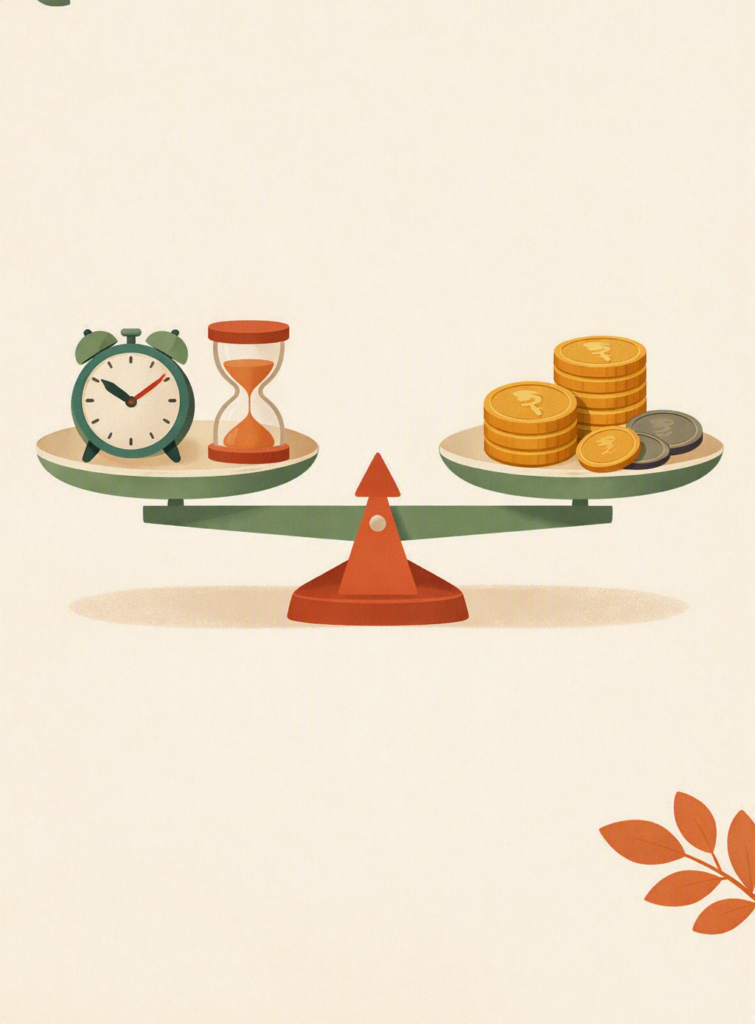
Unlike typical finance guides full of complex spreadsheets and confusing stock market jargon, this Your Money or Your Life book summary highlights how money acts as a direct stand-in for life energy. Once you start managing a household budget through this lens, your daily spending decisions become clear, intentional, and guilt-free. (If you’re new here, check out our recent guide on mindful budgeting techniques for families).
💡 Quick Key Takeaway
Money isn’t just currency; it is a stand-in for the hours of life energy traded to earn it. Budgeting isn’t about restriction, sacrifice, or cutting back—it is about protecting your family’s precious life energy and allocating it toward what truly matters.
1. The Core Concept in This Your Money or Your Life Book Summary: Money = Life Energy
At the heart of Robin’s philosophy in this Your Money or Your Life book summary lies a simple yet revolutionary truth: money is something you choose to trade your life energy for.
Your life energy is limited. You only have a set number of hours in a day, weeks in a year, and years in a lifetime. When your partner goes to work, or when you spend hours managing household operations, that time is spent permanently. You can always earn another rupee, but you can never earn back another hour of your life.
When deciding whether to make a purchase, the standard financial question is usually “Can we afford this?” or “Is it on sale?” Instead, as outlined in this Your Money or Your Life book summary, Vicki Robin challenges us to ask a much deeper question:
“Is this item worth the hours of life energy it cost to earn this money?”
The Shift from Material Cost to Energy Cost
When you evaluate purchases in terms of price tags, a ₹3,000 designer kurta or a quick ₹600 impulse Swiggy food delivery order feels relatively harmless. It seems like a minor line item in a monthly credit card statement.
However, as highlighted in this Your Money or Your Life book summary, when you translate that ₹3,000 into 10 hours of grueling office commute, stressful work deadlines, or missed family dinners, the math changes completely. Suddenly, you aren’t just spending currency; you are spending a piece of your family’s daily existence. This psychological reframe instantly curbs mindless spending without requiring restrictive willpower.
2. A 4-Step Action Plan for Single-Income Indian Households
The principles in this Your Money or Your Life book summary were originally framed for individual salaried workers in Western economies. However, they adapt beautifully to the context of Indian homemakers managing household finances. Here is how to apply the core framework step-by-step.
Step 1: Calculate Your Real Hourly Wage
Most people calculate their earnings by taking their base salary and dividing it by standard working hours (e.g., 40 hours a week). A core lesson in this Your Money or Your Life book summary is that this basic calculation is a complete illusion because earning money costs money and time.
To find the Real Hourly Wage, you must factor in:
- Commute Expenses & Time: Fuel, public transit fares, and the non-payable hours spent stuck in daily traffic.
- Workplace Wardrobe & Grooming: Formal attire, cosmetics, and maintenance required purely to look professional.
- Escape Spending & Convenience Inflation: Buying takeout because you are too exhausted to cook, paying for expensive weekend getaways to escape work burnout, or impulse online shopping after a frustrating day.
The Indian Homemaker’s Angle
In a single-income household, the earning partner’s take-home pay might look great on paper, but after subtracting work-related costs, the real hourly earning rate is often much lower than expected.
As a homemaker reading this Your Money or Your Life book summary, calculating this number transforms how you view household savings. When you save ₹2,000 on monthly groceries through smart planning, meal preparation, or avoiding food waste, you aren’t just saving a small bill—you are preserving hours of your partner’s hard work and returning that time to your family.
Step 2: Track Every Rupee Without Guilt
Most budgeting methods fail because they feel like strict financial diets. They make you feel guilty for buying a coffee, enjoying a treat, or purchasing something special for your home. Vicki Robin’s approach is fundamentally different: tracking is purely about clear awareness, not self-judgment.
| Expense Category | Description & Actionable Examples |
| Needs | Essential housing, utilities, groceries, healthcare |
| Wants | Upgrades, dining out, entertainment, decorative items |
| Values-Aligned | Family health, children’s education, peace of mind |
| Mindless | Unused app subscriptions, forgotten delivery orders |
How to Execute This This Week
- Keep a 7-Day Expense Log: Carry a small notebook or use a simple phone app to log every transaction.
- Include Every Rupee: Log everything from major utility bills down to a ₹20 chai or UPI payment at the local kirana store.
- Categorize at the End of the Week: Group expenses into four main buckets: Needs, Wants, Values-Aligned, and Mindless.
When you examine the “Mindless” category at the end of the month, you will naturally discover quiet money leaks that drain family resources without adding genuine happiness or comfort to your lives.
Step 3: Ask the Three “Is It Worth It?” Questions
For every major expense or recurring spending habit, this Your Money or Your Life book summary suggests applying the book’s signature reflection test by asking these three core questions:
- Did I receive fulfillment, satisfaction, and value proportional to the life energy spent?
- Is this expense aligned with our family’s core values and long-term purpose?
- How would this spending pattern change if working for money were completely optional?
Real-Life Scenario: The Festival & Social Event Trap
In Indian culture, social obligations, festival purchases, and family gifts play a significant role in monthly spending. While community and relationships are valuable, many households spend beyond their means due to social pressure or habit.
By running these expenses through the three questions from this Your Money or Your Life book summary, you can distinguish between spending that brings deep joy to your family and spending done purely to maintain appearances. Aligning expenses with internal values rather than external expectations frees up significant capital while reducing daily social stress.
Step 4: Work Toward the Crossover Point
The most famous financial milestone detailed in this Your Money or Your Life book summary is the Crossover Point.
The Crossover Point occurs when your passive income—generated by growing investments, interest, and dividends—surpasses your actual monthly living expenses. At this exact moment, traditional employment becomes optional rather than compulsory. Work becomes a personal choice driven by purpose rather than a survival necessity.
Reaching the Milestone in an Indian Household Context
For single-income families, achieving complete financial independence might feel like a distant goal, but applying the lessons from this Your Money or Your Life book summary yields immediate, practical benefits:
- Building a Disciplined SIP Portfolio: Channeling freed-up household money into a low-cost Systematic Investment Plan (SIP) accelerates long-term wealth creation.
- Lowering the Baseline Expense Line: By eliminating mindless spending, your monthly expense baseline drops, bringing your family closer to financial resilience much faster.
- Creating a Safety Cushion: Watching passive investment yields cover a larger portion of fixed monthly bills provides immense emotional security for both partners.
Why This Your Money or Your Life Book Summary Matters for Homemakers
Most mainstream financial independence books and corporate wealth podcasts are written for high-earning professionals in office environments. They rarely address the immense economic and emotional value generated inside the home. This Your Money or Your Life book summary shows how the life-energy lens changes that completely:
1. Homemakers Control the Daily Cash Flow
While the earning partner brings income into the home, the homemaker frequently manages daily cash flow—allocating funds for groceries, domestic help, child care, school supplies, home maintenance, and health needs. Every optimization made at home directly protects family resources.
2. Money Saved Has Unique Value
Money saved through thoughtful home management, reducing waste, and prudent purchasing is often more valuable than extra gross income earned. Extra salary is taxed, whereas every rupee saved at home goes directly toward your family’s savings goals or emergency reserves. Re-evaluating how you store these reserves—like setting up an emergency fund for peace of mind—ensures that every saved rupee protects your family’s future.
3. Fostering Healthy Financial Communication
As emphasized throughout this Your Money or Your Life book summary, viewing money as life energy takes the friction and guilt out of family financial discussions. Instead of uncomfortable arguments about “spending too much,” conversations naturally shift toward shared priorities: “How can we protect our time and build peace of mind together?”
📝 Try This Action Step This Week
Ready to put the concepts from this Your Money or Your Life book summary into practice? You don’t need to overhaul your entire household financial system overnight. Start with this simple 4-step exercise:
- Pick One Recurring Expense: Identify one recurring monthly cost—such as unused app subscriptions, daily food delivery apps, or frequent online impulse buys.
- Calculate Its True Energy Cost: Estimate how many hours of hard work or commute it takes your family to earn that specific amount each month.
- Evaluate Its Real Value: Discuss with your family whether that purchase brings enough long-term happiness to justify the time invested.
- Automate Your Savings: Redirect whatever money you free up—even if it is just ₹500 or ₹1,000 per month—directly into an automated monthly SIP or dedicated savings goal.
Over to You
Have you ever calculated what a specific expense costs in terms of your time and energy, not just rupees? I’d love to hear which household category surprised you the most when you looked at it through the lens of this Your Money or Your Life book summary—drop your thoughts and experiences in the comments below!