
If there is one book that keeps showing up in every “must-read personal finance” list, it is Rich Dad Poor Dad lessons by Robert Kiyosaki. And honestly? It deserves the attention — not because it is a literary masterpiece (it repeats itself quite a bit), but because of one foundational idea inside it that has the power to completely rewire how you think about money.
This isn’t a generic book review. I’m not here to debate whether Kiyosaki’s “rich dad” was a real person or a parable. I am breaking down the actual Rich Dad Poor Dad lessons — the ones that matter when you are managing household expenses, running a family budget, and trying to build real wealth instead of just surviving month to month.
1. Two Dads, Two Financial Mindsets
Kiyosaki grew up observing two distinct father figures:
- His biological father (“Poor Dad”): Highly educated, held a stable government job, and believed in the traditional formula: study hard, get a secure job, and work until retirement.
- His best friend’s father (“Rich Dad”): A business owner with no fancy degree, but an entirely different mental model for how capital works.
The poor dad defaulted to: “I can’t afford that.”
The rich dad asked: “How can I afford that?”
That single shift changes a financial barrier into an active project. When managing a household, catching yourself before saying “we can’t afford it” forces you to look for creative ways to increase cash flow or optimize existing resources.
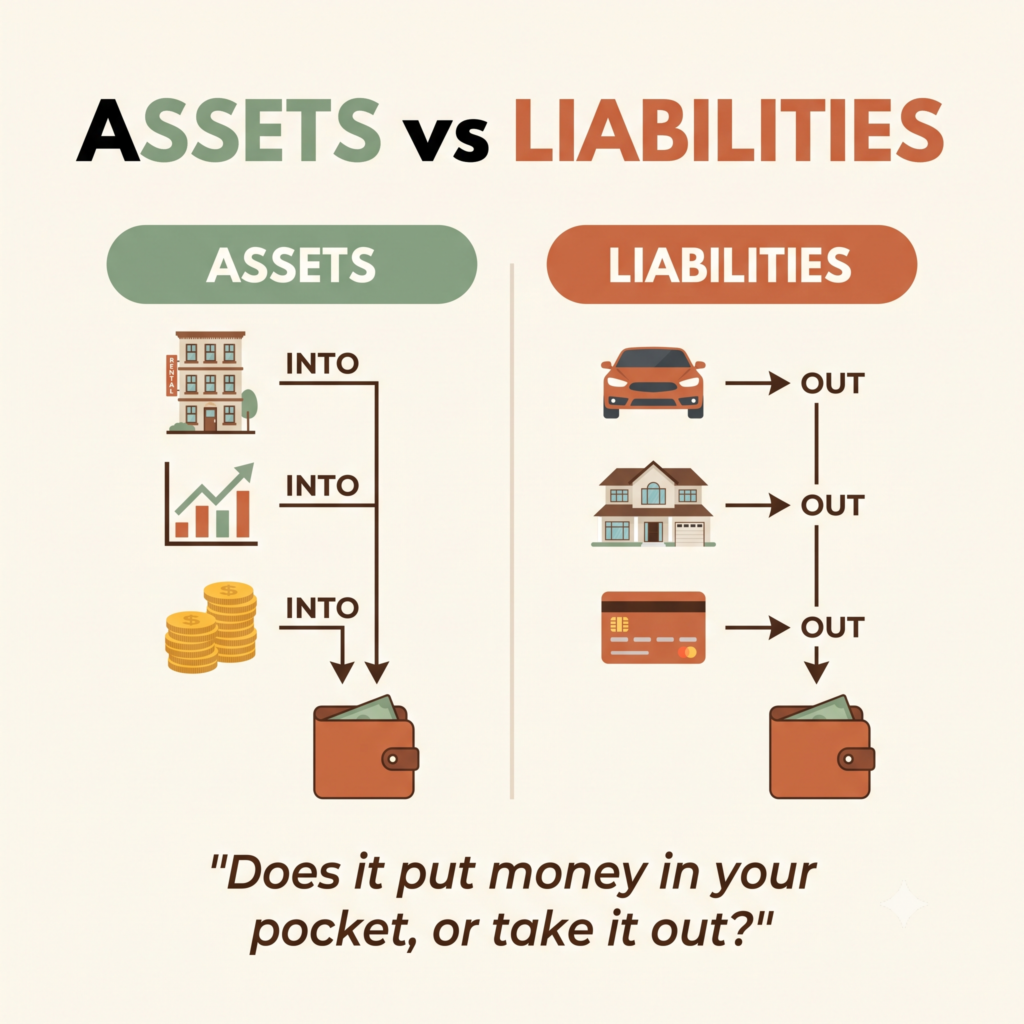
2. The Core Lesson: Assets vs. Liabilities
This is the single most actionable concept in the book. Kiyosaki strips away complex accounting jargon and defines the two terms purely through cash flow:
- Asset: Anything that puts money into your pocket.
- Liability: Anything that takes money out of your pocket.
Most people are taught that their primary residence is their biggest asset. Kiyosaki challenges this directly: if your house is generating monthly EMIs, property taxes, maintenance costs, and repair bills without producing income, it functions as a liability on your monthly cash flow.
The same logic applies to newer cars, phones bought on no-cost EMIs, or decorative furniture upgrades. They feel like milestones, but if they continually pull cash out of your monthly balance, they are liabilities disguised as achievements.
What Counts as a Real Asset?
- Equity investments: Mutual funds, index funds, and SIPs that compound over time.
- Cash-flow real estate: Rental property where monthly income exceeds expenses.
- Businesses: Enterprises that generate revenue without requiring your day-to-day presence.
- Liquid reserves: A solid emergency fund protecting you from high-interest debt.
3. The Three Cash Flow Patterns
One of the clearest Rich Dad Poor Dad lessons highlights three distinct financial paths that determine long-term wealth:
- The Poor: Income goes directly to immediate expenses. Day-to-day survival; zero wealth accumulation.
- The Middle Class: Income goes to liabilities they believe are assets, which creates more expenses and EMIs.
- The Rich: Income is directed into income-generating assets, which compound over time.
A salary hike often leads straight into a larger car loan or a more expensive flat. Income rises, but net worth stays flat because every extra rupee gets locked into a depreciating liability.
4. “Your House Is Not an Asset” — An Honest Family Perspective
Owning a home provides stability, emotional peace of mind, and zero landlord friction — factors a pure cash-flow spreadsheet ignores.
The real takeaway is not to avoid buying a home. It is to avoid letting your home be the only thing you put money into.
When a family directs 100% of their monthly surplus into home loan prepayments or renovations while ignoring equity SIPs and liquid investments, the house stops being a sanctuary and becomes an obstacle to financial independence.
5. Financial Literacy Over Raw Effort
Working hard at a job does not guarantee financial security. Traditional education trains people to be skilled employees, but rarely covers:
- The mechanics of compound interest
- Tax efficiency and asset allocation
- Reading cash-flow statements
- Managing debt-to-income ratios
Financial literacy must be built deliberately through books, tracking tools, and consistent habits.
6. Rich Dad Poor Dad Lessons for Everyday Household Finances
- Run the Pocket Test: Before any major discretionary purchase, ask: “Will this put money into my pocket, or pull money out every month?”
- Separate Investments from Lifestyle: Track monthly equity SIPs and fixed-income assets separately from depreciating personal purchases.
- Reclassify Traditional Purchases: Treat gold jewellery and luxury electronics as personal lifestyle choices rather than wealth-building investments unless they directly generate returns.
- Automate Asset Building: Route a set percentage of your monthly income directly into mutual funds or index funds the day income arrives, rather than investing whatever happens to be left over.
Final Thoughts
These Rich Dad Poor Dad lessons are not a technical investing manual. The book will not teach you how to analyze balance sheets or time market cycles.
Its value lies in forcing you to evaluate where your monthly cash flow actually goes.
Building wealth comes down to a consistent habit: systematically acquiring things that generate cash, while keeping recurring liabilities low enough to give your family breathing room.
Join the Conversation
Have you read Rich Dad Poor Dad? Did the assets vs. liabilities framework change how you look at your own expenses or home loan? Share your experience in the comments below!