
I used to think saving money needed a big moment. A resolution. A dramatic budget overhaul on January 1st. A “from today, everything changes” kind of promise to myself.
Discovering Atomic Habits money lessons broke that belief for me completely.
James Clear‘s core idea is simple and almost annoyingly obvious once you hear it: you do not rise to the level of your goals, you fall to the level of your systems. It’s not about wanting to save more. It’s about building small, boring, repeatable systems that save money for you, automatically, on days when you don’t even feel like being “good with money.”
This book became book two of my 100-day reading challenge — right after my takeaways on building a solid emergency fund for beginners — and honestly, it changed how I look at every money habit in my home, from how I handle the grocery run to how I check my savings account.
Here is everything I took from it, in my own words, and how I’m applying it to real homemaker money life.

🧠 The One Idea That Changed Everything: 1% Better, Every Day
Clear’s central argument is that habits are the compound interest of self-improvement. Get 1% better every day for a year, and you don’t end up 365% better — you end up roughly 37 times better, because improvements compound.
Money works exactly the same way, and this is where the book stopped being a productivity book for me and became a personal finance guide in disguise.
- Saving ₹50 more a day doesn’t feel like anything
- Automating one small SIP doesn’t feel life-changing
- Meal-planning one extra day a week doesn’t feel dramatic
But none of these are meant to feel dramatic on day one. They’re meant to compound quietly while you’re busy living your life. That reframing alone was worth reading the book.
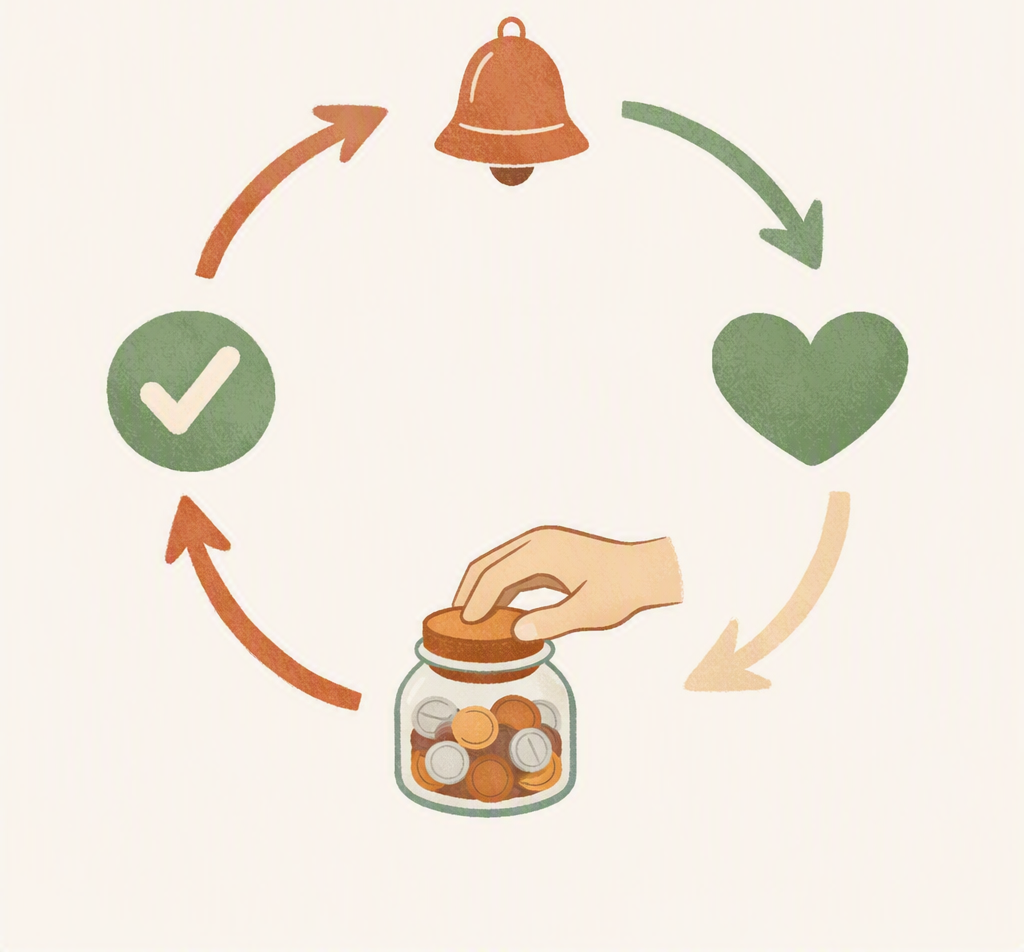
🔁 The Habit Loop: Cue, Craving, Response, Reward
Every habit — good or bad — runs on a four-part loop studied extensively in modern behavioral psychology:
- Cue – the trigger that starts the behaviour
- Craving – the motivation or desire behind it
- Response – the actual habit or action
- Reward – the payoff that makes your brain want to repeat it
I realised my impulse-shopping habit had a very clear loop: cue = bored scrolling after the kids slept, craving = a little dopamine hit, response = adding things to cart, reward = the small thrill of “ordered.” Once I could see the loop laid out like that, it stopped feeling like a personality flaw and started feeling like something I could actually redesign.
📜 Applying Atomic Habits Money Lessons: The Four Laws of Behaviour Change
This is the practical engine of the whole book, and it’s what I’ll be unpacking over my next several posts. Quick summary of how I’ve started applying each law to household finance:
1. Make it obvious
I moved my savings app to my phone’s home screen and put a small sticky note on my grocery jar reminding me of our monthly saving target. Visibility changes behaviour more than willpower ever did.
2. Make it attractive
I started “temptation bundling” — I only let myself watch my favourite cooking videos while doing my weekly budget review. Now I almost look forward to budgeting.
3. Make it easy
This one was huge for saving. I automated a small SIP the day my husband’s salary comes in, before we see the money in our regular account. Clear calls this reducing friction — I call it “paying myself without giving myself a chance to argue.”
4. Make it satisfying
I started a simple visual tracker — colouring one box every day I stick to my no-impulse-buy rule. It sounds almost childish, but the small visual reward genuinely keeps me consistent.
And to break a bad money habit, you simply flip all four laws: make it invisible, unattractive, difficult, and unsatisfying. I deleted saved card details from shopping apps — that one small bit of friction has saved me more than any willpower ever did.
🪞 Identity-Based Habits: The Lesson That Hit Hardest
Out of everything in the book, this is the idea I keep coming back to.
Clear draws a distinction between outcome-based habits (“I want to save ₹1 lakh”) and identity-based habits (“I am someone who saves before I spend”). Outcome goals are about what you want to achieve. Identity goals are about who you want to become — and every small action is a “vote” for the kind of person you’re becoming.
This reframed my entire relationship with money. I stopped thinking “I’m trying to save more this month” and started thinking “I am a mindful, financially intentional homemaker.” Every time I chose to cook instead of order in, or paused before an impulse buy, I wasn’t just saving a few hundred rupees — I was casting a vote for that identity.
If you’re looking for more ways to align your identity with your spending, check out our guide on minimalist budgeting strategies for families.
🏗️ Habit Stacking: My Favourite Practical Tool
The formula is refreshingly simple: “After [current habit], I will [new habit].”
You attach a new habit to an existing one instead of trying to build it from scratch. Some money-stacks I’ve started using at home:
- After I make my morning chai, I will check yesterday’s spending in 2 minutes
- After I put the kids to bed, I will move that day’s loose change or leftover cash into the savings jar
- After the grocery delivery arrives, I will log the bill in my expense notebook
None of these needed extra motivation. They just rode on the back of something I was already doing.
🌿 Environment Design: The Quiet Genius of the Book
Clear’s line that stuck with me: “Environment is the invisible hand that shapes human behaviour.” We like to believe we make decisions purely through willpower, but so much of what we do is a response to the space around us.
Practical shifts I made at home:
- Keeping cash for discretionary spending in an envelope, physically visible, so overspending feels tangible
- Removing saved payment methods from shopping apps
- Keeping my budgeting notebook on the kitchen counter, not tucked away in a drawer
Small environment tweaks, big behaviour shifts.
✅ My Personal Lessons-Learned Checklist
Here’s what I’m actually carrying forward from this book into my own financial life:
- Automate one small saving before I ever “see” the money
- Track one habit visually — even a simple tracker keeps me honest
- Reframe savings goals as identity statements, not outcome targets
- Use habit stacking to attach money check-ins to existing routines
- Redesign my environment to make good money habits obvious and bad ones invisible
- Remember the two-minute rule — start new habits in a version so small it’s hard to say no
💭 My Honest Take
What I appreciated most about Atomic Habits is that it never asks you to be a different person overnight. It respects that most of us are already tired, already stretched between a hundred small responsibilities, and it simply says: build small systems, let time and repetition do the heavy lifting.
For a homemaker managing a household budget without a fixed monthly salary of her own, this felt less like a productivity book and more like permission — permission to stop chasing dramatic financial transformations and instead trust tiny, repeatable actions to add up.
This is exactly the kind of mindful money habit-building I want this blog to be about, and over the next several posts in this challenge, I’ll be breaking down each of these ideas — the four laws, habit stacking, identity-based habits — into small, doable money exercises you can try at home this week.
Applying these Atomic Habits money lessons reminded me that most of us are already tired and stretched. You don’t need a dramatic financial transformation—just small, repeatable systems.
Have you ever tried building a money habit and had it fail because it felt too big to sustain? Tell me in the comments — I’d love to hear what’s worked (or not worked) for you. 💬