
Most of us were taught a simple formula for money: study hard, get a stable job, work long hours, save what you can. If you are looking for practical Naval Ravikant wealth lessons, this book offers a very different way to think about money. It’s a decent formula to start with, but it has a ceiling, because there are only so many hours in a day, and you can’t sell more of them than you have.
The Almanack of Naval Ravikant, compiled by Eric Jorgenson from Naval’s tweets, podcasts, and interviews, introduces a mindset focused on ownership, leverage, and building things that work for you even when you’re resting. Applying these key Naval Ravikant wealth lessons can completely shift your perspective. You can learn more about the book’s origins on the official Naval Ravikant Almanack Website (Set this external link to DoFollow in WordPress).
If you want to grow your income without burning out, these core Naval Ravikant wealth lessons are worth your time to study and apply. Let’s break down the main ideas. 🌿
💰 Lesson 1: Essential Naval Ravikant Wealth Lessons on Wealth vs. Money
Naval separates three ideas we usually mix together when exploring foundational Naval Ravikant wealth lessons:
- Wealth is the stuff that earns while you sleep: businesses, investments, digital products, anything that creates value without your constant presence.
- Money is simply how we transfer value. It’s a tool, not the goal.
- Status is where you rank in other people’s eyes. It’s a zero-sum game, and a tiring one.
His point: chase wealth, not just money or status. A big salary that requires every hour of your week is money. A small business or asset that keeps producing while you spend time with family is wealth.
Try this: Ask yourself, “If I stopped working for a month, what would still bring in money?” If the answer is “nothing,” that’s your starting point, not a failure, just a direction.
🕰️ Lesson 2: You Won’t Get Rich Renting Out Your Time
This is the heart of the book. If you’re paid by the hour, or by fixed effort, your income is capped by how many hours you can work. Among the most critical Naval Ravikant wealth lessons, he teaches that real wealth comes from owning equity—a piece of something that scales—rather than trading time for a paycheck.
That doesn’t mean quitting your job tomorrow. It means slowly building something you own alongside it: a blog, a small business, digital products, a skill people pay for repeatedly.
For homemakers, freelancers, and side-hustlers, this is powerful. Your time may be limited, so building assets that outlast a single day of work matters even more.
🔍 Lesson 3: Build “Specific Knowledge”
Specific knowledge is a skill or expertise that can’t be easily taught in a classroom or replaced by someone following a manual. It usually comes from your own curiosity, experience, and passion, the things you’d happily do even when nobody is paying you.
Naval’s idea is that if you’re deeply interested in something and get very good at it, society will eventually need what you know, and pay for it.
How to find yours:
- What do friends always ask you for help with?
- What could you talk about for hours without getting bored?
- What have you learned through real-life experience that others struggle with?
Your everyday experience, like managing a household budget, planning meals, or organizing a home, can become specific knowledge when you combine it with your own perspective and share it.
🚀 Lesson 4: Use Leverage to Multiply Your Effort
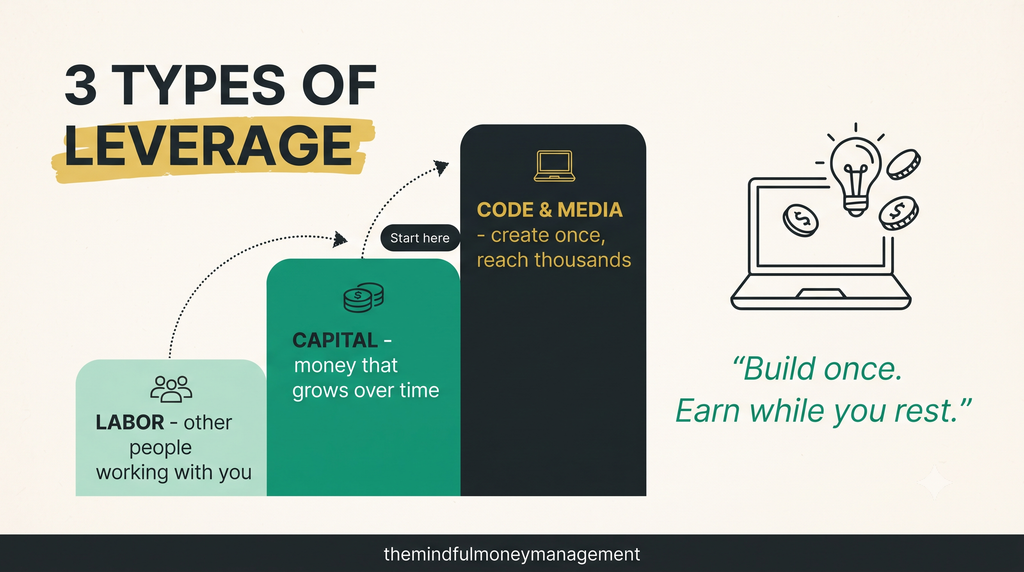
Naval explains that leverage is what lets one person’s effort produce a much bigger result. He describes several forms:
- Labor: other people working with you (the oldest form, and the hardest to manage).
- Capital: money that can be invested to grow.
- Code and media: products that can be copied and shared with no extra effort. This is the permissionless leverage of the modern age.
Think about it: a blog post, a video, an ebook, or a template you create once can be read or used by thousands of people, while you’re asleep or with your family. You don’t need anyone’s permission, just a phone or laptop and the willingness to learn.
That’s why writing, creating digital products, and building a small audience online can be such a smart path for beginners.
📈 Lesson 5: Play Long-Term Games, With Long-Term People
Naval says compound interest works not only with money but with reputation, relationships, and skills. Small efforts repeated over years build enormous results. Consistency beats intensity.
He also encourages you to work with people who think long-term: honest, reliable, and in it for the journey. Short-term thinkers waste your time, and the wrong partnerships drain your energy.
Try this: Choose one habit you can commit to for a year: writing weekly, learning one hour a day, posting consistently. Boring consistency beats occasional bursts.
📚 Lesson 6: Read a Lot, Think Clearly, Own Your Judgment
Naval believes the ability to make good decisions, which he calls judgment, is one of the most valuable skills you can build. And how do you build it? By reading widely, thinking deeply, and learning from experience.
He also stresses learning the fundamentals, like math, basic economics, and how things actually work, instead of chasing trendy shortcuts. Deep understanding lasts far longer than surface tips.
Try this: Read something that actually challenges you every day, even just 20 minutes. Over a year, that’s a serious edge.
🧘 Lesson 7: Wealth Without Peace Isn’t Wealth
Here’s what makes this book different from most money books: Naval spends a lot of time on happiness and peace of mind. He argues that happiness is a skill you can train, that constant desire creates constant dissatisfaction, and that no amount of money fixes an anxious mind.
For a mindful money blog, this matters. Building wealth while ignoring your mental health, relationships, or physical wellbeing is a bad deal. His advice includes:
- Protect your time and attention
- Reduce comparison with others
- Enjoy the process, not just the destination
- Be comfortable being alone with your thoughts
True wealth includes freedom, health, and calm, not just a balance sheet.
🌿 How This Fits Mindful Money Management
If you’ve followed this blog, you know we love intentional living: tracking spending, reducing clutter, and making conscious choices. Integrating these core Naval Ravikant wealth lessons adds the growth side of that story.
- Mindful spending protects what you have (you can review our guide on the 50/30/20 budgeting rule for more on that).
- Mindful earning builds what you’ll have.
Together, they create a complete picture: keep more, and create more, with intention.
✅ Your Naval Action Checklist
Pick one or two this week. Don’t try everything at once.
- ☐ Write down 3 topics you’re genuinely curious about or already know well
- ☐ Circle one that others might pay to learn or solve
- ☐ Decide on one form of leverage: writing, video, a digital product, or a small service
- ☐ Commit 30 minutes a day to building it for the next 30 days
- ☐ Read or listen to one idea from the book each morning
- ☐ Ask: “Am I trading time for money, or building something I own?”
Progress beats perfection. A small asset started today beats a perfect plan started never.
💬 Final Thoughts
The Almanack of Naval Ravikant isn’t about hustling harder. It’s about working smarter, owning what you build, and protecting your peace while you do it. You don’t need to be a tech founder or a millionaire to apply these ideas. You need curiosity, consistency, and the courage to start building something that’s yours.
If you’ve ever felt that a regular paycheck alone won’t get you the freedom you want, mastering these Naval Ravikant wealth lessons gives you a mindset, and a map, to start creating your own path.
(Disclaimer: This post shares lessons from a book for educational purposes and is not personal financial or investment advice. Please consider your own circumstances and consult a qualified professional for financial decisions.)
🗨️ Let’s Talk
If you could build one thing that earns for you even while you sleep, what would it be? Share it in the comments, I’d love to cheer you on. 💛
Loved this? Catch up on our previous breakdown of Die With Zero, check out insights from The Psychology of Money, or follow along for more lessons from the 100-day book challenge as we build a wealthier life together!