
Welcome back to our 100-day money journey! If you are looking for a practical I Will Teach You to Be Rich book summary, you’re in the right place.
If you’ve ever made a beautiful, color-coded budget on a Friday night… and abandoned it by the following Wednesday, this book is for you. Ramit Sethi’s I Will Teach You to Be Rich isn’t another guilt-trip finance book telling you to skip your coffee. It’s a system — a slightly cheeky, no-nonsense system — for building wealth on autopilot.
🎯 The Core Idea: A “Rich Life” Isn’t One-Size-Fits-All
Before any spreadsheets or bank accounts, Ramit insists on one thing: define what a Rich Life actually means to you. For one person that’s never worrying about a grocery bill. For another, it’s a lavish annual trip. For someone else, it’s simply not fighting with their spouse about money.
The point is that personal finance is deeply personal. Ramit’s system isn’t about depriving yourself of everything — it’s about spending extravagantly on the things you love, and cutting mercilessly on the things you don’t. That reframe alone is worth the price of the book. It moves you from “I can’t afford anything” to “I’m choosing exactly what I want to afford.”
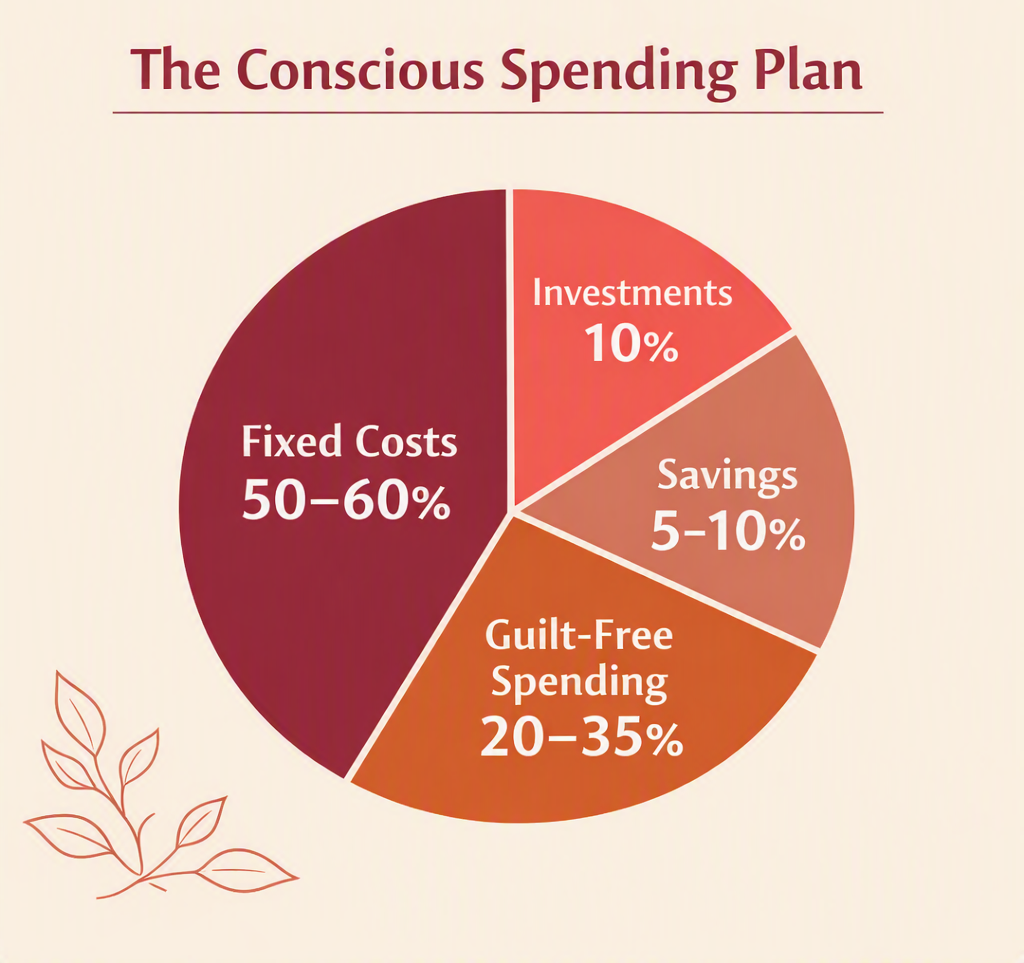
🏦 The Conscious Spending Plan (Not a Budget)
Ramit famously refuses to call this a “budget,” because budgets fail — they’re restrictive, joyless, and nobody sticks to them past January. As you build your Conscious Spending Plan in this i-will-teach-you-to-be-rich-book-summary, Ramit breaks it down into four broad buckets
- Fixed Costs (50-60%) — rent, utilities, groceries, insurance, minimum debt payments
- Investments (10%) — retirement accounts, index funds, long-term wealth building
- Savings (5-10%) — emergency fund, big purchases, vacations
- Guilt-Free Spending (20-35%) — dining out, shopping, hobbies — spent with zero guilt because it’s already accounted for
Notice what’s missing? There’s no line item micromanaging your daily latte. Once the big buckets are funded, what’s left is genuinely yours to enjoy. This single framework quietly kills the anxiety-shame spiral so many of us carry around spending.
⚙️ Automation: The Real Star of the Book
If there’s one lesson to tattoo on your forehold from this book, it’s this: systems beat willpower.
Ramit’s Ladder of Personal Finance sets up an automated waterfall where your salary flows, without you lifting a finger every month, into:
- Employer retirement match (free money — always grab this first)
- High-interest debt payoff
- Retirement accounts (maxed out where possible)
- Pre-set savings goals (house, wedding, vacation)
- Additional low-cost index fund investments
The genius here is that once it’s set up, your money moves before you’re tempted to spend it. You’re not relying on your future self to be disciplined at 11 pm while online shopping — the decision was already made by your past self, once, calmly, with a clear head.
When looking at the wealth-building systems highlighted throughout this i-will-teach-you-to-be-rich-book-summary, automation is the absolute star.
📉 Ditch the Guilt, Fix the Big Wins
A theme running through the book that feels almost rebellious: stop obsessing over small expenses and focus on the “Big Wins” — the handful of decisions that move the needle by thousands of rupees or dollars, not a few coins.
Big Wins include things like:
- Negotiating your salary (a one-time conversation with a lifetime of compounding payoff)
- Automating investments instead of trying to time the market
- Choosing low-fee index funds over expensive actively-managed funds
- Negotiating recurring bills (internet, insurance, subscriptions) once a year
Compare that to obsessing over whether to buy the ₹300 coffee. Ramit’s math is blunt: cutting lattes for a decade saves you far less than one successful salary negotiation. This doesn’t mean spend recklessly — it means direct your energy where it actually compounds.
🧾 Credit Cards Are Tools, Not Traps
Unlike many finance authors who tell you to cut up your credit cards, Ramit takes the opposite stance: credit cards, used correctly, are one of the most powerful tools available. The trick is treating them like a debit card — only spend what you already have — while automating full payments every month to avoid interest entirely.
Used this way, a credit card becomes a rewards machine and a credit-score builder, not a debt trap. The danger was never the card itself; it was the lack of a system around it.
📈 Investing Doesn’t Need to Be Complicated
Ramit is famously allergic to stock-picking, day-trading, and “hot tips” from that one uncle at family gatherings. His investing philosophy in one sentence: buy low-cost, diversified index funds regularly, and leave them alone for decades.
He walks readers through opening and funding retirement/investment accounts, automating monthly contributions, and picking a simple target-date or index fund instead of trying to beat the market. It’s unglamorous. It’s also exactly how most self-made millionaires actually build wealth — slowly, boringly, consistently.
As we explore the core investment takeaways of this i-will-teach-you-to-be-rich-book-summary, remember that investing doesn’t need to be complicated.
💬 Talking About Money (Even When It’s Awkward)
One of the more underrated chapters tackles the emotional side: talking to partners, friends, and family about money. Ramit pushes readers to have real, calm conversations about spending habits, shared goals, and financial boundaries — rather than avoiding the topic until it explodes into a fight.
This ties back beautifully to the Rich Life concept. Money conversations aren’t about being “right” — they’re about aligning your systems with the people you share your life with.
✅ 5 Lessons You Can Apply This Week
- Write your Rich Life sentence. One line describing what you’re optimizing for.
- Set up one automatic transfer today — even a small one — from checking to savings or investments.
- Audit your Big Wins, not your daily coffee. Is your salary fair? Are your fund fees low?
- Negotiate one recurring bill this month — internet, insurance, or a subscription.
- Have one honest money conversation with your partner or a close family member this week.
🌿 Final Thoughts on This I Will Teach You to Be Rich Book Summary
I Will Teach You to Be Rich strips away the shame that so much financial advice carries and replaces it with something far more sustainable: a system you set up once and trust. It’s not about depriving yourself — it’s about being deliberate, automating the boring stuff, and spending guilt-free on what actually makes your life richer.
As we wrap up this i-will-teach-you-to-be-rich-book-summary, over the next 10 days we’ll be breaking down these ideas even further. — from building your own Conscious Spending Plan to setting up your first automated investment ladder. Follow along as we turn these lessons into real, lived habits. 🌱
What’s one bill or subscription you’ve been meaning to negotiate or cancel? Drop it in the comments below — let’s hold each other accountable! 👇