
Track your net worth, Let’s be honest — we’re all a little obsessed with salary numbers. A promotion, a raise, that six-figure milestone… we treat these like the ultimate proof that we’re “doing well.” Every family gathering, every LinkedIn update, every casual chat with a friend eventually circles back to the same question: “So what’s the package now?”
We’ve been trained to believe that a bigger paycheck automatically means a better financial life. But here’s the thing nobody tells you in the usual budgeting advice: your salary is not your wealth.
You could be earning really well every month, and still watch it all disappear before the next paycheck even lands. That’s not wealth — that’s just being high-income and broke at the same time.
If you actually want financial freedom . the kind where money feels calm instead of chaotic, where you’re not constantly bracing for the next bill . you need to stop obsessing over what you earn and start paying attention to what you keep. That’s where net worth comes in. When you choose to track your net worth, you shift your focus toward long-term security.
💸 The Trap of a “Good” Salary
It’s so easy to fall into this. Your salary goes up, and without even noticing, your lifestyle quietly expands right along with it — a slightly bigger home, a nicer car EMI, more subscriptions, more weekend outings, a slightly fancier grocery cart.
None of this feels reckless in the moment. Each individual choice seems reasonable. But add them all up, and a raise that should have given you breathing room instead just… vanishes into a slightly upgraded version of the same tight month.
From the outside, it all looks like progress. Nicer things, a nicer address, a nicer life on paper. But underneath, things can be shakier than they seem. One layoff, one health scare, one unexpected expense — and suddenly that “successful” life feels very fragile. The safety net that should be there just… isn’t.
That’s because a salary is just cash flow. It needs your time and your energy to keep showing up every single month. The moment you stop working — by choice or by circumstance — that income disappears with you.
Wealth is different. Wealth is what still supports you even when you stop working. It’s the cushion that lets you take a career break without panicking, start something of your own without fear, or simply breathe a little easier during uncertain months. And the only real way to track that kind of security is your net worth.
🧮 So What Is Net Worth, Really?
It sounds fancier than it is. When you strip away the jargon and learn how to track your net worth, it comes down to one simple subtraction:
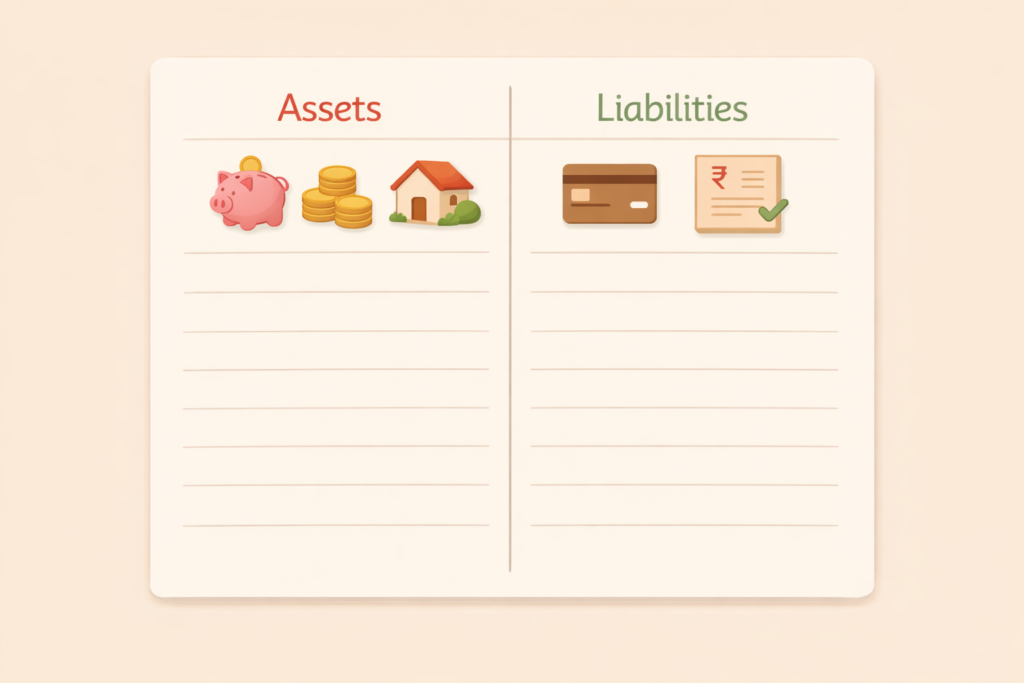
Net Worth = What You Own − What You Owe
That’s it. One simple equation that tells you more about your financial reality than any salary slip ever could.
What you own (assets):
- Your everyday savings and checking account balances
- Your emergency fund
- FDs, mutual funds, stocks, and retirement accounts
- The current market value of any property you own
Notice what’s not on this list — your clothes, your furniture, your gadgets. Assets are things that hold or grow in value, not things that depreciate the moment you buy them.
What you owe (liabilities):
- Credit card dues carried forward month to month
- Personal or student loans
- Car loan balance
- Home loan / mortgage
Subtract one from the other, and you get one honest number — your real financial starting point. Not what you earn. Not what you look like you have. What you actually, truly have.
🌱 Why Net Worth Beats Salary, Every Single Time
1. It shows you lifestyle inflation you can’t see otherwise
A raise can hide bad habits really well. If your income jumps 20% but your spending quietly jumps right along with it, your net worth stays exactly where it was. When you track your net worth every month, you force yourself to see the real impact of your spending.
2. It gives you the full picture, not just a monthly slice
Regular budgeting only shows what came in and what went out this month. It’s like looking at your finances through a straw. But when you track your net worth, it zooms out to show the full picture.
3. It shifts your mindset from earning to building
When salary is all you track, the only question in your head is “how do I earn more?” When you choose to track your net worth instead, the question quietly shifts to “how do I use what I already have to buy back my time and freedom?”
✅ A Simple, No-Overwhelm Way to Track It
You don’t need a 15-tab spreadsheet with complicated formulas to do this well. In fact, the simpler your system is, the more likely you are to actually stick with it. Most people quit tracking not because it’s hard, but because they made it too complicated in the first place.
Here’s a four-step routine that genuinely takes about five minutes a month:
- Pick one fixed day. The 1st of the month or the last weekend both work well. What matters isn’t the exact date — it’s showing up on the same day, every time, so it becomes a habit rather than a chore.
- Gather your numbers. Log into your banking and investment apps and note down your cash balances, your investment totals, and any outstanding loan amounts. Don’t stress about daily market ups and downs — you’re just capturing one honest snapshot in time, not predicting the future.
- Log it simply. One column for what you own, one column for what you owe, and let a simple formula handle the subtraction for you. No manual calculators, no mental math at 11 PM.
- Close it and walk away. This is a long game, not a daily obsession. Checking your net worth every single day will just stress you out over tiny market wobbles that don’t actually matter in the long run. Once a month is genuinely, completely enough.
That’s the entire system. No spreadsheets with fifteen confusing tabs, no formulas you need an accounting degree to understand — just one honest number, tracked once a month, quietly building into a story of real progress.
📥 Want a Head Start?
If you’d rather not build this system from scratch, I’ve already done the work for you. The Minimalist Net Worth Tracker v1.0 is a clean, fully automated template designed to give you complete clarity over your numbers in under five minutes a month — no clutter, no confusing tabs, just total financial peace of mind.
👉 Grab the Minimalist Net Worth Tracker v1.0 here
Just plug in your numbers once a month, and let the template handle the rest.
🏡 Why This Matters Even More If You’re Managing a Household
If you’re someone running a home — juggling groceries, school fees, EMIs, and everyone else’s schedules before your own — net worth tracking can feel like “one more thing” to add to an already full plate. But this is exactly why it matters so much.
Household finances rarely live in one neat place. There’s the joint account, the small personal savings tucked away, the gold, the recurring deposit nobody’s touched in two years, the credit card that gets used for “just this month.” Without one number pulling all of it together, it’s incredibly easy to feel financially busy without actually knowing where you stand.
Net worth gives you that one number. It’s not about tracking every rupee that moves through the house — it’s about stepping back once a month and seeing the whole picture clearly, so you can make decisions from a place of clarity instead of guesswork.
🪞 The Real Shift Happens Slowly
Here’s what nobody mentions about this practice: the first month you track your net worth, it probably won’t feel like much. It’s just a number sitting in a sheet.
But the second month, you’ll notice a small change. The third month, a pattern starts to emerge. By month six, you’ll actually be able to see your progress in a way a salary slip never shows you — because a salary slip resets every month, but your net worth carries forward every single decision you’ve made along the way.
This is the quiet, unglamorous work of real financial freedom. It’s not about one big lucky break or one massive raise. It’s about consistently choosing to build instead of just spend, and having one honest number that keeps you accountable to that choice, month after month.
Your salary is what people see. Your net worth is what’s actually true. Once you begin to track your net worth, you’ll never want to go back to guessing.
Do you track your net worth already, or is this something you’ve been meaning to start? Tell me in the comments — I’d love to hear where you’re at on this. 💬