
Picture your wardrobe right now. Be honest — how many of those clothes have you actually worn in the last three months? If you’re like most of us, it’s probably less than half. The rest is just… sitting there. Taking up space. Quietly draining money you worked hard to earn.
I used to think a “full” wardrobe meant I was prepared for anything — every occasion, every mood, every possible Instagram moment. Turns out, it just meant I was prepared to waste money. Closet after closet, season after season, I kept buying “just one more thing” without ever asking the real question: was my wardrobe actually working for me, or was I working to fill it?
That question changed everything. Let’s talk about the massive capsule wardrobe financial benefits you can unlock. It isn’t just a style trend — it’s one of the smartest, most overlooked financial decisions you can make as a homemaker managing a household budget.
👗 What Exactly Is a Capsule Wardrobe?
A capsule wardrobe is a small, curated collection of clothes — usually somewhere between 25 and 35 pieces — chosen specifically because they mix and match effortlessly to create dozens of outfit combinations. The idea isn’t new; minimalist dressers have followed some version of a capsule wardrobe for decades.
Transitioning to this setup is a core pillar of a minimalist lifestyle. It proves that sustainable fashion isn’t just good for the planet; it’s an absolute necessity for a healthy household budget.
But what makes it powerful isn’t the aesthetic. It’s the financial discipline baked into the concept. Think quality over quantity, but with a clear money-saving purpose behind every choice. Understanding these capsule wardrobe financial benefits is the key to shifting your mindset from consuming to saving.
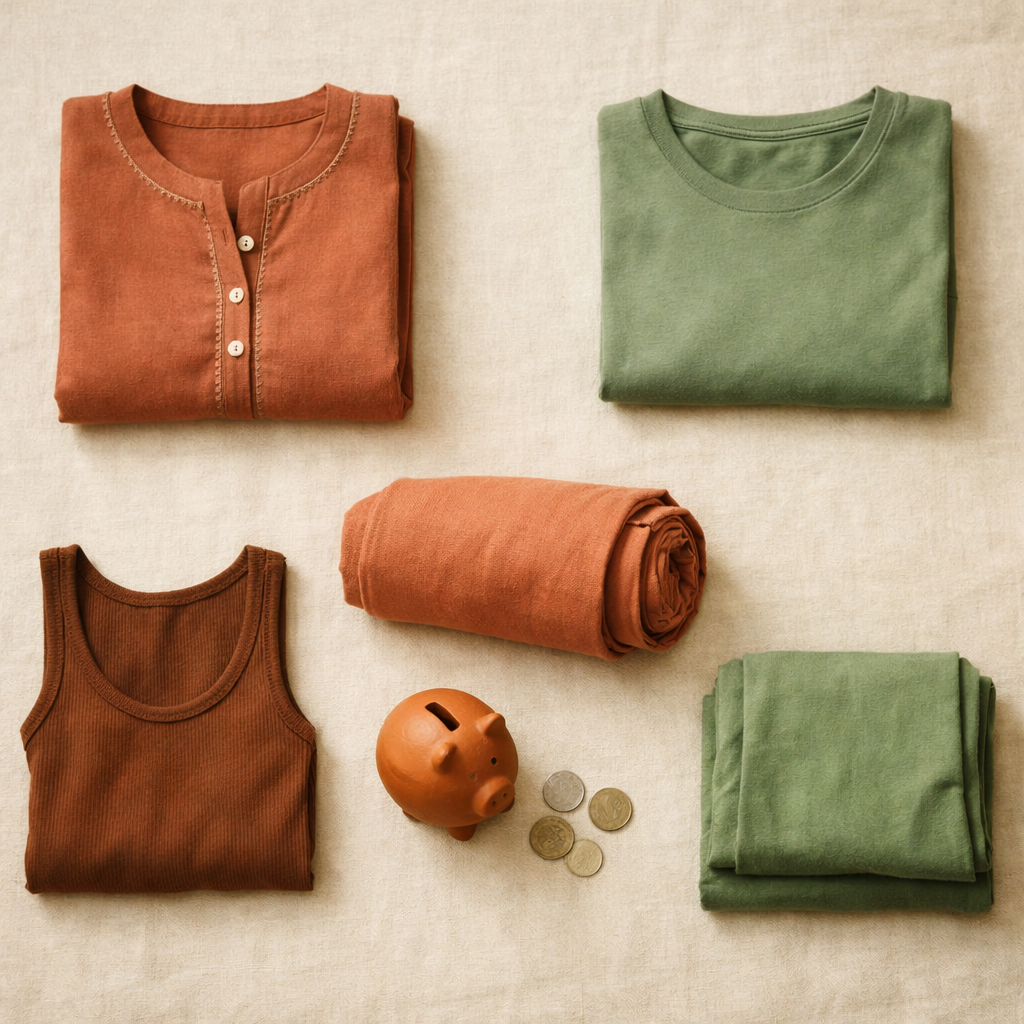
For Indian homes, this doesn’t mean giving up your sarees, kurtas, or festive wear — and it definitely doesn’t mean dressing like everyone else. It means being intentional: a handful of versatile cotton kurtas for daily wear, two or three well-made sarees for occasions, comfortable and breathable home wear, and a few transitional pieces that work equally well for kitchen duty, school pickup, or that unexpected guest who drops by unannounced (we all have that one relative).
The goal isn’t a smaller wardrobe for the sake of it. The goal is a wardrobe where every single piece earns its place — both in your closet and in your budget.
💰 The Real Math Behind “Less Is More”
Here’s where it gets genuinely interesting for those of us who track every rupee.
The cost-per-wear reality
This is the single most important shift in thinking you can make about clothing spends. A ₹500 kurta worn 50 times costs you ₹10 per wear. A ₹2,000 “statement” outfit worn twice costs you ₹1,000 per wear. On paper, the cheaper item looks like the better buy — but most of us don’t actually calculate cost-per-wear before shopping. We calculate “is this on sale” or “will this look good in photos,” which are completely different (and far less useful) questions.
Once you start mentally running this calculation before every purchase, your shopping habits shift almost automatically. Suddenly, you start seeing the long-term capsule wardrobe financial benefits, and that trendy piece you’ll wear once for a wedding doesn’t look like such a bargain anymore.
The hidden costs of clutter
An overstuffed wardrobe isn’t just a storage problem — it’s money in disguise, hiding in places we don’t usually look:
- Duplicate purchases because you genuinely forgot you already owned something similar — this happens far more often than we’d like to admit when a closet is overflowing
- Impulse buys that fill an emotional gap, not an actual wardrobe gap — stress shopping, boredom shopping, “I deserve this” shopping
- Damaged or moth-eaten clothes from improper storage, simply because there are too many items packed into too little space with no room to breathe
- The mental tax of decision fatigue — ironically, more clothes often leads to more “I have nothing to wear” mornings, which then leads to panic-shopping for “just one more outfit”
Auditing these hidden leaks forces us to re-evaluate our daily spending habits and recognize what a true wardrobe essential looks like, keeping our money where it belongs.
Each of these is a quiet leak in your household budget. None of them show up as a single big expense you’d notice — they bleed out ₹200 here, ₹500 there, month after month, until you look back at a year of spending and wonder where it all went.
The Compounding Impact of Capsule Wardrobe Financial Benefits
This is the part that should really grab your attention. If a family of four cuts unnecessary clothing spends by even ₹2,000 a month, that’s ₹24,000 a year sitting unused in your budget. Invested in a simple recurring deposit or a mutual fund SIP, that amount compounding over 5-10 years adds up to genuinely meaningful wealth — money that could go toward your child’s higher education, a family emergency fund, or that home renovation you’ve been postponing, instead of sitting unused in your almirah as clothes nobody touches.
Money saved on clothing isn’t just “money saved.” When redirected properly, it becomes money that grows.
🧮 How to Build Your Capsule Wardrobe (Without Spending More)
The best part about this approach? You don’t need to buy a whole new wardrobe to unlock these savings. In fact, the entire point of capitalizing on capsule wardrobe financial benefits is to spend less, not more. Start with what you already own.
- Audit before you buy anything — Pull everything out of your wardrobe, every single piece, and sort into three honest piles: “wear often,” “occasion only,” and “haven’t touched in over a year.” Be ruthless here. This step alone usually reveals just how much money is sitting unused in your closet.
- Identify your core colors — Pick 2-3 base colors that work with most of what you already own, so everything mixes and matches naturally. Earthy tones, indigo, cream, and warm neutrals tend to work beautifully across both daily wear and festive pieces in an Indian wardrobe context.
- Fill gaps strategically, not emotionally — Only buy what’s genuinely missing after your audit. If you already have five kurtas in a near-identical style and color, you don’t need a sixth, no matter how good the sale looks.
- Follow the one-in, one-out rule — For every new piece that enters your wardrobe, one piece leaves — donated, sold, or repurposed into something useful around the house. This single habit prevents the slow creep back into clutter.
- Invest in cost-per-wear pieces — Spend a little more on items you’ll wear weekly, like good-quality daily-wear cotton sets that hold up to washing and Indian weather. Spend a little less on items you’ll only wear occasionally. This is the opposite of how most of us naturally shop, but it’s where the real savings live.
🪔 Why This Fits the Indian Homemaker Lifestyle Perfectly
We already manage households with incredible precision — tracking grocery prices across vendors, planning months ahead for festivals, stretching the monthly budget to cover school fees, household help, and a hundred small emergencies. Bringing capsule wardrobe financial benefits into your home is simply extending that same mindful, resourceful approach to our own closets.
It also solves a very real, very Indian household problem: storage. Smaller wardrobes mean less almirah clutter, easier maintenance during the seasonal switch (think monsoon storage, winter woolens packed away), and clothes that actually get aired and cared for properly instead of being crushed at the back of a shelf for two years, slowly losing their shape and fabric quality.
There’s also a quieter benefit here — one that doesn’t show up in spreadsheets but matters just as much. A simplified wardrobe means simplified mornings. Less time standing in front of an overflowing closet feeling like you have “nothing to wear” despite owning dozens of outfits. That’s time and mental energy you get back, every single day, to spend on the things that actually matter to your family.
✨ The Bigger Picture
Ultimately, embracing capsule wardrobe financial benefits isn’t about deprivation, and it’s certainly not about looking “boring” or sacrificing style. It’s about redirecting money — real, meaningful money — from closets full of “maybe someday” clothes into things that actually build your family’s financial future. An emergency fund that gives you peace of mind. Your child’s education. A small investment that quietly compounds in the background while you go about your day, no longer worrying about clothes you bought but never wore.
Fewer clothes. Less clutter. More clarity. More wealth. These capsule wardrobe financial benefits form a simple, powerful formula. It just requires the same intentionality you already bring to every other corner of running your household — applied, finally, to your own closet.
It’s not a complicated formula. It just requires the same intentionality you already bring to every other corner of running your household — applied, finally, to your own closet.
What’s one piece in your wardrobe right now that you know you haven’t worn in over a year? Tell me in the comments — let’s hold each other accountable, and maybe even inspire each other to finally clear that shelf! 👇