
Let me ask you something honest — when was the last time you opened your bank app without that little knot in your stomach?
If you hesitated just now, you’re not alone. Financial anxiety is one of the most quietly exhausting things we carry. It’s not always about being broke or in debt (though that’s real and valid too). Sometimes it’s just this low-level hum of “I should be doing better with money” playing on repeat in the background of your day.
Here’s what I’ve learned though: the solution isn’t always a 30-day financial overhaul, a complicated budgeting spreadsheet, or listening to finance podcasts for two hours every weekend. Sometimes the most powerful thing you can do is tiny. Ridiculously, almost embarrassingly tiny.
That’s where micro-habits come in.
These are small, low-effort actions — each taking less than five minutes — that, when done consistently, completely shift the way you feel about your money. Not just how you manage it. How you feel about it. And that shift? It changes everything.
So let’s talk about 3 micro-habits that can quiet your financial anxiety in less than 10 minutes a week. Yes, total. For the whole week.
🧾 Micro-Habit #1: The 2-Minute Monday Money Check-In
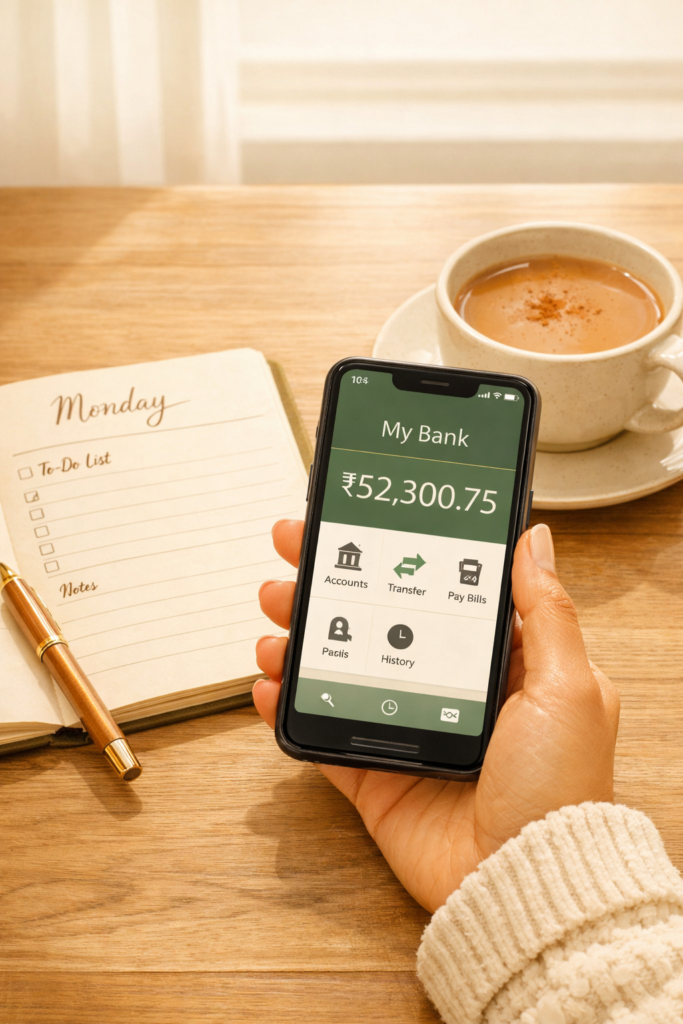
Pick any Monday morning — right after your chai, before the day gets loud — and spend exactly two minutes looking at your account balance.

That’s it.
No analyzing. No calculating. No judging yourself for that weekend splurge. Just look. Open the app, see the number, and close it.
Now, I know what you’re thinking. “That sounds too simple to actually help.” But here’s the thing — most financial anxiety doesn’t come from knowing what’s in our account. It comes from not knowing. Our brain, bless it, tends to catastrophize the unknown. When we avoid checking our balance, our mind quietly fills in the blank with worst-case scenarios.
When you check in regularly — even for just two minutes, even when the number isn’t what you want it to be — you replace that vague dread with actual information. And real information, even uncomfortable information, is always less scary than the story your anxious brain makes up.
Over time, this habit retrains your nervous system. What once felt threatening starts to feel routine. Your Monday check-in becomes as neutral as checking the weather.
How to make it stick: Set a weekly Monday alarm labeled something warm and non-threatening — like “Quick Money Hello 👋” — so it doesn’t feel like a chore.
✍️ Micro-Habit #2: The Weekly One-Line Money Note
At the end of each week — Friday evening works well — write one single sentence about your finances in a notebook or your phone’s notes app.
Just one line. Like:
“Spent more on groceries this week, but stayed within overall budget.”
“Transferred ₹500 to savings today — small but it counts.”
“Noticed I bought things out of stress twice this week.”
That’s your entire micro-habit. Thirty seconds. One line.
What this does is remarkable. Most of us have a very blurry relationship with our own financial patterns. We know money comes in and goes out, but we rarely reflect on the emotional side of it. This one-line note builds what I like to call your money awareness muscle.
Over a few weeks, you’ll start to notice themes — maybe you overspend midweek, maybe savings feel easier right after payday, maybe certain emotions trigger certain purchases. This awareness is worth more than any budgeting app because it helps you understand your specific money behavior, not just generic rules.
There’s also something quietly powerful about acknowledging a small win in writing. Transferred a little to savings? That counts. Paid a bill on time? That counts. We’re so quick to notice where we failed with money and so slow to celebrate the small wins. This habit fixes that imbalance.
How to make it stick: Keep your notebook on your bedside table, or create a pinned note on your phone labeled “Money Notes.” No grammar rules, no one is reading this but you.
🎯 Micro-Habit #3: The Sunday Two-Minute Intention
Every Sunday, spend two minutes setting one simple financial intention for the upcoming week.
Not a goal. Not a target. An intention — which is softer, kinder, and way more sustainable for anxious minds.
It could be something like:
- 🛒 “This week, I’ll pause before any non-essential purchase and ask myself if I really need it.”
- ☕ “I’ll make coffee at home three times instead of buying outside.”
- 📱 “I’ll unsubscribe from one app or service I’m not using.”
- 💰 “I’ll put whatever’s leftover from today’s budget into savings before sleeping.”
Notice how none of these require a big life overhaul. They’re designed to be achievable — because when we keep our money promises to ourselves, even tiny ones, we build financial self-trust. And financial self-trust is the antidote to financial anxiety.
Here’s something that often gets overlooked in personal finance advice: anxiety isn’t just about numbers. It’s about feeling out of control. Setting a weekly intention — and then actually following through — gives you back a sense of agency over your money. It reminds your brain that you are doing something. You are in the driver’s seat. Even if you’re just steering by a few degrees.
How to make it stick: Pair it with something you already do Sunday evening — like planning the week ahead, prepping meals, or watching something cozy. Make it part of your Sunday wind-down, not an extra task.
🌿 Putting It All Together: Less Than 10 Minutes a Week
Let’s add it up, just to prove the point:
- 🗓️ Monday: 2-minute account check-in
- 📝 Friday: 30-second one-line money note
- 🌞 Sunday: 2-minute financial intention
Total: under 5 minutes of active effort. Even if you add some buffer time, you’re well under 10 minutes for the whole week.
That’s it. That’s the whole system.
It won’t make you rich overnight. It won’t erase debt or fill an empty savings account in a week. But it will do something arguably more important — it will shift your relationship with money from one of avoidance and dread to one of gentle, consistent awareness.
And from that place of calm awareness? Real change becomes possible. Bigger decisions become clearer. Financial goals start to feel like something you can actually reach instead of distant destinations you’re vaguely hoping to stumble into.
💬 A Final Thought
You don’t have to have it all figured out to start feeling better about money. You just have to show up — for two minutes, once a week — with a little curiosity instead of fear.
Try these three micro-habits for just four weeks. Keep it simple. Be kind to yourself when a week slips by. And notice what shifts — not just in your bank account, but in that knot-in-the-stomach feeling.
Because quieting financial anxiety isn’t about perfection. It’s about progress, one tiny Monday at a time. 💚
Which of these micro-habits are you going to try first? Drop it in the comments — I’d love to know! And if you found this helpful, share it with a friend who needs a calmer relationship with money.